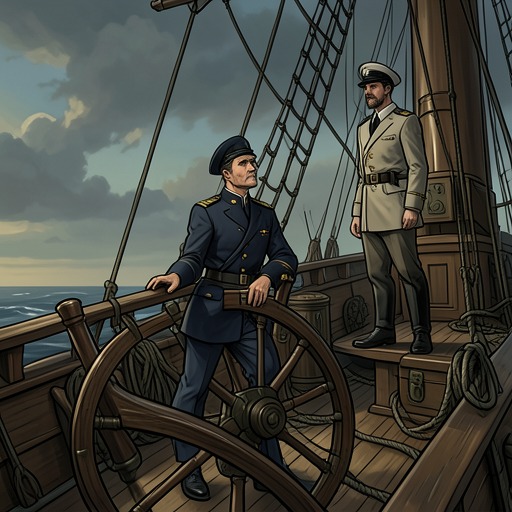
Maryk’s court-martial
The Caine Mutiny Court-MartialSteve Maryk’s court-martial turns the disputed transfer of command aboard the USS Caine into a legal and moral test: did Maryk willfully and without authority remove Commander Queeg, or did Queeg’s condition make intervention permissible? The trial places official records, medical testimony, and remembered conduct under competing interpretations. Its verdict acquits Maryk, but the route to that decision exposes how the same evidence can support sharply different accounts of command and responsibility.
Stakes and the courtroom
The consequences facing Maryk are severe. As the trial approaches its decisive stages, he believes that Commander Queeg, Tom Keefer, and Urban have already finished him off, yet clings to a remnant of faith in his defender because conviction is too dreadful to contemplate. The maximum penalty is dismissal and fifteen years’ imprisonment. That prospect gives the proceedings a personal urgency beyond the abstract question of authority: the court’s interpretation of one act may determine whether Maryk remains in the Navy or loses his career and freedom.
On the second morning, Willie Keith is summoned from the anteroom at two minutes past ten. He follows the orderly through several doors and enters the courtroom in a daze, physically experiencing the same tingling in his arms and legs that he had felt when the Caine approached an invasion beach. His perception fixes on solemn faces and an American flag that seems immense and unnaturally vivid. Sworn as a witness, he is asked whether he was the Caine’s officer of the deck during the forenoon watch on December 18. The question anchors the case in a particular watch and date, while Willie’s disorientation conveys how the courtroom itself has become a site of danger for those involved.
Medical evidence and the defense case
The competing positions sharpen around whether Queeg was sick and, if so, whether his illness had made him unable to command. Greenwald withdraws a statement during the examination of Dr. Bird, but Bird will not withdraw his description of Queeg as sick. Challee spends ten minutes trying to get him to retract the word. Bird becomes agitated, querulous, and dogmatic, resorting to medical terminology, but holds to his judgment. Challee eventually excuses the hostile psychiatrist. The episode leaves the word at issue in the record even as the exchange shows how difficult it is to make a medical conclusion answer the legal question of incapacity.
The prosecution then introduces the medical board’s report, a doctor’s report from Ulithi, several of Queeg’s fitness reports, and logs and other records from the Caine. These documents place the case within a formal record of examinations and service, rather than leaving it solely to recollections of shipboard conduct. At three o’clock, Captain Blakely asks whether the defense is ready. Greenwald says he has only two witnesses and names the first as the accused. At his lawyer’s nod, Maryk stands and requests permission to testify. The evidence supplied here establishes his decision to take the stand, but not the substance of his testimony; the important change is that the accused himself now becomes part of the defense’s presentation.
The opposing closing arguments
In his opening argument for the prosecution, Jack Challee portrays the defense as irrelevant to the charge and specification. He argues that Commander Queeg received an obsolete, deteriorating ship, brought it through fifteen months of combat without loss, and completed numerous assignments to his superiors’ satisfaction. In Challee’s account, the record contains no complaint from Queeg’s superiors, only accusations from subordinates. He presents Queeg’s performance despite inner tensions and hostile officers as evidence of a conscientious and successful commander, not an unfit one.
Challee then narrows the legal dispute: he says the defense has not produced psychiatrists to contradict the medical board, and argues that the board has nullified the defense’s reliance on Articles 184, 185, and 186. He characterizes Maryk’s act as a willful, unauthorized relief of a Navy commanding officer, and maintains that expert testimony established Queeg’s handling of the ship during the typhoon as sound and as good as circumstances permitted. These are the prosecution’s claims to the court, not a neutral resolution of the contested evidence.
Greenwald’s manner is markedly different. After Challee’s forceful argument, he speaks softly, hesitantly, and apologetically, explaining that he had reluctantly undertaken the defense at the judge advocate’s request. He says the defense depends on demonstrating the mental incompetence of a Navy officer and insists that its case does not rest on calling Queeg a coward. Instead, Greenwald asks the court to consider whether illness explains questionable conduct under fire. He reviews the damaging evidence against Queeg, emphasizes that both psychiatrists admitted in some form that Queeg was sick, and places the central judgment with the court: whether the illness was severe enough to incapacitate him. He also points to Queeg’s evasiveness, incoherence, changing stories, and inability to stop speaking in court as further evidence of illness. His argument gives little attention to Maryk himself; it returns instead to the condition of the commander whose authority Maryk displaced.
Acquittal and aftermath
The court deliberates for an hour and ten minutes before acquitting Maryk. The verdict rejects the prosecution’s demand that the charge be proved, but the evidence does not describe the court’s private reasoning. Its significance lies in the result: Maryk is not convicted for relieving Queeg, despite the prosecution’s insistence that the action was unauthorized and unjustified.
Outside the court-martial building, relief becomes a public celebration. Maryk’s mother clings to him, weeping and laughing, while his father stands beside her, quietly patting her shoulder. The Caine’s officers have gathered, and Willie Keith capers, shouts, and slaps people on the back. Tom Keefer calls for a celebration, and the crowd answers with a ribald chorus. The scene shifts the event from legal argument to bodily, communal release: the man who had faced dismissal and imprisonment is acquitted, and his shipmates greet the outcome with unrestrained joy. Yet the competing arguments remain part of the verdict’s meaning. The trial has decided Maryk’s criminal liability; it has not made the underlying conflict between formal command and judgment under pressure disappear.